Architecture
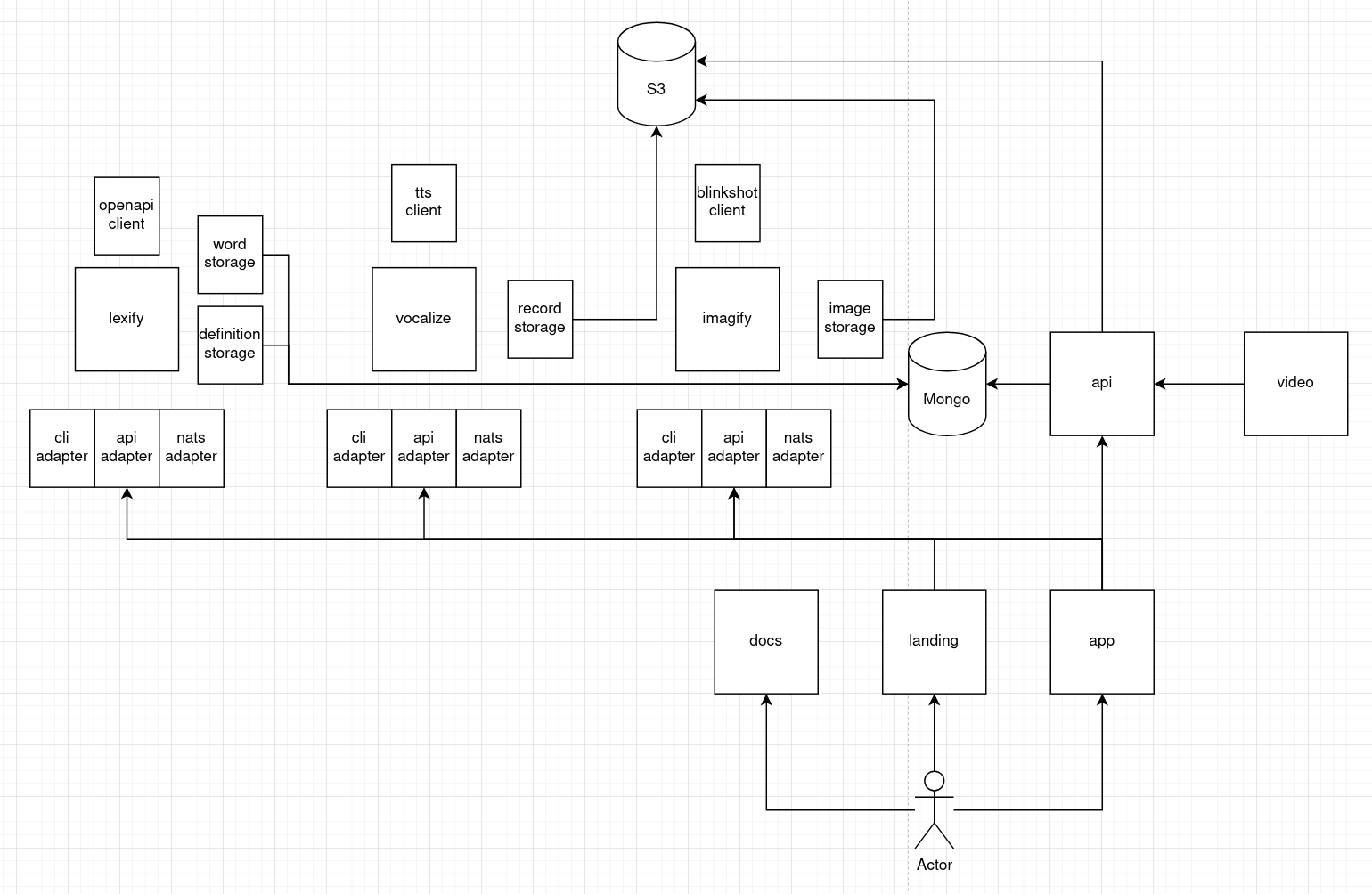
Our backends can be divided into 3 main parts:
- Definition services
lexify- generates word definitions- uses llm to generate definition
- stores definition in mongodb
- uses word storage to check if word is correct
vocalize- responsible for word pronunciation- uses llm to generate word pronunciation
- stores pronunciation in s3
imagify- generates images of words- uses AI to generate image
- stores image in s3
Those services work independently of users and are not aware of most db collections.
You can use them not only by API but also as CLI. Thanks to hexagonal architecture they are easy to test and extend (for example to queue interface like NATS).
- API
Only HTTP based communication is allowed and in most cases requires JWT token, so interacting with API you are acting as user saved in db.
- Auxilary
video, this service waiting for new videos requests defined by users in API and then return stream with ready video to save forAPI.
These services can't be running without API and fully relay on it.